
2.0 Introduction
This issue 2. of the South Sudan Series examines the peace negotiation process that culminated with the CPA and how it fits within the context of southern Sudan’s experience with political violence. While providing a summarized analytical perspective of the CPA, this section articulates the nature of engagement in the agreement and how it addresses the southern Sudan protracted conflict.
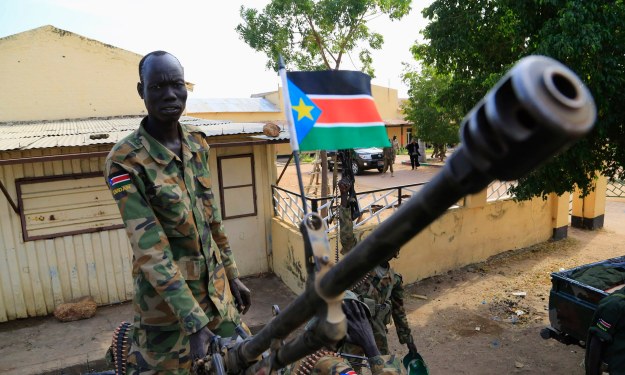
South Sudan Government Soldier – December 2013. Photograph: theguardian 31 December 2013
2.1 A Compendious Account of the 2005 CPA
The CPA, sometimes referred to as the Naivasha Agreement, is a set of agreements culminating in January 2005 from more than two and half years of negotiation between the insurgent SPLM/A and the GoS. It was meant to bring to an end the second north-south Sudanese Civil War; make unity of the Sudan attractive by developing and promoting democratic governance, accountability, equality countrywide and share oil revenues (CPA 2005: xi). In the event that such a framework failed to redress the grievances of the population of southern Sudan and to meet their aspirations, southern Sudan would have a referendum on its independence from the north and become a sovereign state. The CPA comprised six protocols i.e. the Machakos protocol, the security arrangements, the power sharing arrangement, wealth sharing, the resolution of the Abyei, and the resolution of conflict in the Southern Kordofan state and the Blue Nile state.
2.1.1 The Machakos Protocol (2002)
The Machakos protocol set out a six-year interim period starting 9 July 2005 during which the people of southern Sudan would have the right to govern affairs of their region through a federal system of government and participate equitably in the national government. The peace implementation was therefore to be conducted in a manner that made unity of Sudan attractive. However, the implementation of the peace process had to remain within the remit of the six-year period after which the south would exercise their rights to self-determination by voting in an internationally monitored referendum that would ultimately confirm their support for either national unity or secession.
One of the most frequently cited factors that contributed to the unsettling of the Addis Ababa agreement and a return to war in 1983, was a lack of religious and cultural freedom and the introduction and imposition of Sharia el Islam law (Wenyin, 1988; Natsios 2012; Beshir 1975; Ahmed 1988). In an attempt to address the issue of Islamisation and Arabisation of the southern Sudanese by GoS, Sharia law was to remain applicable in only the north to the Muslims with parts of the national constitution re-written so as to ensure that Sharia was not applied to any non-Muslims throughout Sudan.
However, as has been argued by both Ackermann (2000) and Annan (1999), one of the most fundamental prerequisites for successful conflict prevention is timeliness. It can be highlighted that the incidence of political and economic inequalities alluded to protocol though crucial in the realization of the national unity could not be redressed within the six years provided by the protocol. The six-year interim period should have been seen only as a start to a long term process of democratic transition that would in the long run redress socio-economic and political inequality laying foundation for a productive unity.
If the arguments presented by the proponents of state making theorists and the political economy discussed in issue 1. of this series is to be used in Sudan’s case, then the CPA’s presentation of development, democracy, and national unity as a mechanism upon which the governance and state building is measured seems to represent a very misleading conception of the conflict. Especially when the processes that led to the realization of such apparatus of government (democracy, development, justice and law) are either prone to conflict or are a product of violence themselves (Tilly 1985, 1999; Snyder 2000; Duffield 2007; Mann 1999). This process requires strong institutions that will not only normalize such violence but also engage with the periphery to effectively neutralize the negative or the unpredictable impacts of such apparatus of governance (Duffield 2007).
2.1.2 The Security Arrangements (2003 & 2004)
This protocol provided that during the six-year interim period, Joint Integrated Units (JIUs) be formed with equal numbers from the Sudan Armed Forces (SAF) and the SPLA. If, after the interim period, the south decided to secede, the JIUs would integrate into a one strong force. Each army was to be downsized and the parties would implement demobilization, disarmament and reintegration (DDR) programmes. No other armed group would be tolerated outside the umbrella of the three services. A permanent cessation of hostilities was provided for, detailing disengagement and the creation of various committees for enforcement and oversight. DDR and reconciliation were provided for through a number of commissions. Monitoring was to be carried out by a UN mission to support implementation, as provided for under Chapter VI of the UN Charter.
What can be pointed out here is that the CPA did not provide for the representation of interest groups such as pastoralists, farmers and the vast peasant majority and other displaced/refugee population in the commission (Tania 2006). As noted earlier, the point of contestation between the Sudan and southern Sudan governments has always been the issue of legitimacy and where such legitimacy is drawn by those in possession of state powers (Yongo-Bure 1988). It can be argued that the CPA seemed to systematically ignore the center-periphery interaction and its importance in influencing the source of legitimacy and its contribution to the process of state-making. Consequently, because the CPA ignored the population engagement, the functionality of the agreement was to be determined by reference to whether the GoS and the GoSS fulfilled their obligations as set by the international patrons rather than their population (Johnson 2011).
In contrast to the Leviathan argument of security arrangements, the CPA implied that the legitimacy at this stage was predicated on its ability to function within the advanced propositions but not with respect to any form of contract between the state/SPLA and the population whatsoever. The return to war in the Nuba Mountain, Abyei and South Kodofan regions therefore confirmed the argument in section 1.2.5 that there was a social contract entered into between these regions and the SPLA who failed to deliver what was expected.
For example the CPA provided for DDR. However, while the SPLM/A attempted to disarm civilians in the south, the GoS continued to support armed paramilitary groups in and along the borders of the south (Johnson 2011). The disarmament action therefore became counterproductive further undermining the internal security in the south as conflicts/armed resistance in places like Jongolei state was exacerbated. The unwillingness of the CPA or its disregard of the immense prerequisite to understand the nature of political culture of southern Sudan since independence solely built on a militarized understanding of both socio-economic and political interaction.
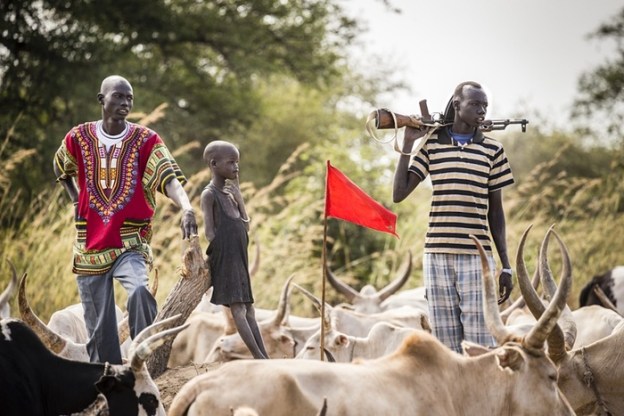
Socio-Economic Fabric of South Sudan is founded on a militarized form of Interaction. Photographs: Marcus Perkins/Saferworld
2.1.3 Power Sharing (2004)
In an attempt to further the provisions of the 2002 Machakos Protocol, the Power Sharing Protocol, designed to be in force until the elections, provided for greater representation of the south through the SPLM in the Government of National Unity (GoNU). This protocol provided that Sudan would have both a national government with representation from both sides of the north-south conflict, and a separate government for the south.
The GoNU which was to be formed under this protocol would further the CPA objective of establishing a system of government that would correct the imbalances that had prevailed since the 1956 independence. The protocol provided for a decentralized system of government granting more power to individual states with a 70:30 share of state government position between National Congress Party (NCP) and SPLM/A respectively for the GoNU and the reverse in favour of SPLM in the southern states.
However, the Power Sharing agreement failed to recognize or include other regions, political parties and paramilitary groups operating within the region in its provisions (Komey 2013; Ahmed 2010). Some of the parties left out by the protocol included National Democratic Alliance (NDA), National Umma Party (NUP), Hassan al-Turabi’s Popular Congress Party (PCP) and the population of Sudan (Johnson 2011; Schultz 2010). Johnson (2011) argues that this created room for the NCP to negotiate deals with individual opposition parties outside the state without giving-up their position in state governments. This created room for political manoeuvre by the GoS consequently frustrating the implementation and realization of the CPA.
The CPA is also criticized for undermining its own principles of providing a model for good governance in Sudan and the creation of a solid basis of preserving peace and making unity attractive. Al-Mahdi (2006) argues that the agreement guaranteed control of the north to the NCP in the form of 52% of National Assembly seats prior to elections, and guaranteeing control of the south to SPLM with 70% of seats in the Southern Sudan Assembly pending elections. There was therefore nowhere in the agreement stipulating that the NCP, an authoritarian party, and the SPLM, a shadow of its former incarnation the SPLA, both be transformed into democratic organisations. Al-Mahdi (2006) further presents that the CPA was merely a limited bilateral agreement between the GoS and SPLM/A, one of the many paramilitary groups fighting in the country. It was therefore far from being comprehensive in addressing matters of national interest. Consequently, the agreement proved a stumbling block towards addressing the complex political and armed conflicts in the country.
While accounting for the failure of the Addis Ababa Agreement, Yongo-Bure (1988) argues that the agreement considered the south as a unified region downplaying the inter-communal conflict within the south for instance between the Dinka and the Nuer (the two largest tribal groups in South Sudan) focusing its effort on the north-south relationship. The south-south division crippled the implementation of the Addis Ababa agreement and gave the GoS under President Nimeri an opportunity to take full advantage of the disunity in the south to advance a non-representative political strategy (Dak 1988). The Power Sharing agreement seems to have made no provision whatsoever to address specific grievances amongst SPLM/A hence the inadequacy in the provision of prior arrangements for cooperation among southerners to guarantee a smooth transition from war to peace in the south in the event of a referendum.
2.1.4 Wealth Sharing (2004)
This protocol was greatly influenced by the rational economics based account of civil conflict in developing countries for interventionism (Collier & Sambanis 2005). The proponents of this thesis argue that the abundance of mineral resources (oil in this case) acts as a ‘honey pot’ that provides incentives for rent-seeking[1] to different groups in South Sudan who tend to take violent actions in trying to gain access or control to such resources (Collier & Hoffeler 1998; De Soysa 2000). With statistics showing that oil contributed up to 98% of south Sudan’s total revenue in the period leading up to the CPA, the proponents of the CPA, convinced that oil was the largest cause of and sustenance of the conflict, believed that by resolving the management, distribution and control of oil rents the political violence in the country would end.
In regards to access to and exercise of taxation, the CPA provided that the national government was to collect revenue from personal income, corporate and customs taxes, whereas the GoSS would collect revenue from personal income taxes, luxury taxes and business taxes only within the remit of southern Sudan. Since GoS controlled revenues from oil, the lack of state visibility in the south meant that the collection of other revenues by the GoSS was practically impossible. This provision left GoSS with a worryingly narrow tax base with IMF (2009) reporting that 98% of south Sudan export earnings were from oil while for the Government in Khartoum this was 65%. This therefore left south Sudan heavily dependent on oil revenue. Critics of the agreement have argued that the provisions in the wealth sharing protocol, especially on the oil revenue which provided for a 50/50 share between GoS and GoSS, lacked transparency (Dewal 2006; Young 2012).
As a result, the CPA implementation failed to spend oil revenue on development projects in the south during the transition period until the last few months of 2011. This therefore meant infrastructures that forms the most fundamental basis upon which governance is built, such as roads, railways, schools and health facilities, which would consequently produce peace dividends and promote unity among the South Sudanese population were absent (Young 2012; ICG 2011).
Baker (2011) presents that over 70% of the South Sudan population had no access to basic services like education, healthcare, food security and roads. According to the Millennium Development Goals (MDG) Report (2012) 131 in 1,000 children in South Sudan were acutely undernourished. This reduced slightly in 2010 to 122 in 1,000. The statistics get more disturbing for expectant women with 2,054 in 100,000 women dying in childbirth in 2006 with the figure slightly reducing to 1,989 deaths per 100,000 in 2010. The report also points out that for every 1,000 children born in 2006, more than 135 never lived to see their fifth birthday. The number of deaths however dropped slightly to approximately 105 of 1,000 in 2010. Although the statistics above presented by the UN’s MDG Report (2012) highlight some relative levels of progress, this progress is a direct result of activities/interventions of NGOs and Civil Society organization and aid funds rather than that of the CPA’s oil money. This further crippled the legitimacy of the government to not only provide security and services to its population, but also to effectively tax its population.
As illustrated above, critics have argued that the only significant result of the wealth sharing protocol is that the two parties (GoS & SPLA) agreed to solve the oil issue, i.e. the production of oil in the south Sudan and its transportation to the only available port and refinery located in the north (Johnson 2011; Al-Mahdi 2006). This success seems to simply represent a typical case of a mutual satisfaction of economic self-interest among the elites of the two negotiating parties and the international community but not the national interest.
[1] Rent-seeking is defined as those activities that seek to create, maintain or change the rights and institutions on which particular rents are based (Cramer 2006; Di John 2007).
 Permanent Condemnation
I believe the best was to have a one state of Sudan but with clear Federal political practice.
LikeLiked by 1 person
Thank you Aturia Angelo Olinga for you comment and contribution, whether or not the objective of a unity state of Sudan would have attracted stability in the country is a puzzle that we might never have the opportunity to solve. However, as was sighted by several scholars in the aftermath of the 1983 collapse of the 1972 Addis Ababa peace agreement, one of the factors that contributed to the return to conflict in addition to the islamisation of public service delivery, is the decentralisation approach that was taken up by the state at the time. whether it was as a result of a lack of clarity of this decentralisation practice or a lack of civic awareness of the fundamental benefits and potential of the decentralisation itself is one gray area within the South Sudan/Sudan’s Scholarship that we cannot clearly point out. It’s therefore difficult to categorically or empirically show how clarity of a federal political practices would have addressed or could have avoided the current crisis in South Sudan considering that a multitude of dimensions were at play which goes beyond a single political system.
However, one area that I do agree with you that the people of Sudan and now South Sudan needs clarity in the direction they would love their country to go and that can only be demonstrated by a clear political strategy and careful implementation of such strategy.
LikeLike